
How to Choose the Right HPLC Frit Porosity
Posted by Ian Ford on Jun 24th 2026
Choosing the right HPLC frit porosity is not just a matter of selecting the smallest pore size available. The frit needs to retain particles effectively while still allowing the system to maintain appropriate flow, pressure, and long-term performance. In HPLC, UHPLC, LC/MS, and OEM chromatography applications, the wrong frit can contribute to high backpressure, restricted flow, clogging, poor reproducibility, or premature component failure.
This guide explains how frit porosity affects chromatography system performance and how to think through pore size selection when specifying a new frit, replacing an existing frit, or designing a custom fluidic assembly.
Quick Answer: How to Choose HPLC Frit Porosity
Choose frit porosity based on the particles you need to retain, the flow rate, allowable pressure drop, sample cleanliness, solvent conditions, frit thickness, and the overall fluidic design. Smaller pore sizes can improve fine-particle retention, but they may also increase flow restriction and clogging risk. Larger pore sizes can reduce restriction, but they may not retain fine particles as effectively.
What Does an HPLC Frit Do?
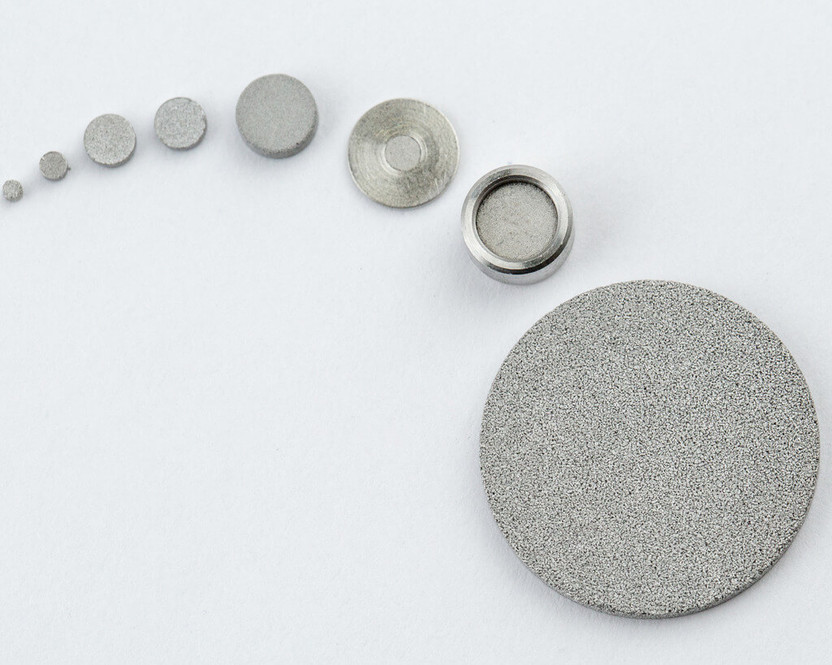
A frit is a porous component used to control, filter, support, or distribute fluid flow in an analytical system. In HPLC and UHPLC systems, frits may be used in columns, inline filters, guard columns, fittings, flow restrictors, sample paths, or OEM assemblies.
Depending on the application, a frit may help:
- Retain particles or packing material
- Protect downstream components from particulate contamination
- Support consistent flow through a fluidic path
- Improve system reliability by reducing debris-related issues
- Serve as part of a flow-control or filtration assembly
- Support custom chromatography system testing requirements
Because frits interact directly with the mobile phase and sample path, porosity, material, diameter, thickness, and cleanliness all matter. For custom stainless steel and titanium options, see OPTI-FRIT sintered frits.
What Is Frit Porosity?
Frit porosity refers to the pore size of the porous structure. In chromatography applications, porosity is commonly expressed in microns. A smaller micron rating generally means finer particle retention. A larger micron rating generally allows easier flow, but with less fine-particle retention.
For example, a 0.5 micron frit will typically retain smaller particles than a 2 micron frit, but it may also create more resistance to flow depending on the system, solvent, particle load, frit thickness, and overall fluidic design.
The key is balance. The frit should be fine enough to perform its filtration or retention function, but not so restrictive that it creates unnecessary backpressure or becomes prone to clogging.
Why Smaller Pore Size Is Not Always Better
It can be tempting to choose the smallest pore size available because it seems like the safest option. In practice, that is not always the best choice.
A smaller pore size may improve fine-particle retention, but it can also increase the risk of:
- Higher system backpressure
- Faster clogging if samples or solvents contain particulates
- Longer equilibration or flushing time
- More sensitivity to contamination
- Reduced usable life in dirty or high-particulate workflows
In many applications, the best frit is not the smallest frit. It is the frit that provides the required particle retention while maintaining acceptable flow and pressure.
Common HPLC Frit Porosity Considerations
The right porosity depends on the application, but the following guidelines can help frame the decision.
| Porosity Range | Common Use | Important Tradeoff |
|---|---|---|
| 0.2 micron to 0.5 micron | Fine filtration, small-particle retention, sensitive workflows, LC/MS-related fluid paths, and downstream component protection | May increase flow restriction and clogging risk if samples, solvents, or systems are not clean |
| 2 micron | General chromatography and fluidic applications where a balance of particle retention and flow is needed | May not provide the same fine-particle retention as smaller pore sizes |
| 5 micron to 10 micron | Lower-restriction support, flow-control, OEM assemblies, and specialized filtration designs | Will not retain fine particles as effectively as smaller pore sizes |
0.2 Micron to 0.5 Micron Frits
Fine-pore frits are often used when small-particle retention or fine filtration is important. These frits may be useful in high-sensitivity applications, fine filtration paths, LC/MS workflows, or systems where downstream protection is critical.
The tradeoff is that fine-pore frits may be more restrictive and more vulnerable to clogging if sample preparation, solvent filtration, or system cleanliness is not well controlled.
2 Micron Frits
A 2 micron frit is a common choice for many chromatography and fluidic applications where the system needs a practical balance between particle retention and flow. In many cases, 2 micron frits provide enough retention for the application without creating as much flow restriction as finer pore sizes.
This does not mean 2 micron is always correct. It simply means it is often a practical starting point when fine filtration is not the primary requirement.
5 Micron to 10 Micron Frits
Larger-pore frits may be appropriate where flow resistance needs to be minimized or where the frit is being used in a less restrictive support or flow-control role. These frits may be useful in certain OEM assemblies, flow restrictors, or specialized filtration designs.
The tradeoff is that larger pores will not retain fine particles as effectively as smaller pores.
How Frit Porosity Affects Backpressure
Backpressure is one of the most common signs that a frit may be too restrictive, contaminated, clogged, or mismatched to the application. As pore size decreases, resistance to flow can increase. As particulate matter accumulates in the frit, resistance can increase further.
When troubleshooting high backpressure, it is important to consider:
- Has the frit become clogged?
- Is the pore size too small for the sample or solvent conditions?
- Is sample preparation allowing particulates into the system?
- Is the frit thickness contributing to flow resistance?
- Is the system operating at a flow rate that is appropriate for the frit geometry?
- Is the frit material compatible with the mobile phase and sample chemistry?
A frit that works well in one system may not be ideal in another. Pressure, solvent viscosity, flow rate, sample matrix, particle load, and system design can all influence frit performance. For additional troubleshooting guidance, read what causes HPLC frit clogging and high backpressure.
Need help matching porosity to your application?
OPTI-FRIT sintered frits can be quoted around material, porosity, diameter, thickness, testing, and application-specific performance requirements for HPLC, UHPLC, LC/MS, OEM chromatography, flow control, and critical filtration applications.
Do Material and Thickness Matter Too?
Yes. Porosity is only one part of frit selection.
Frit material can affect chemical compatibility, corrosion resistance, bioinertness, and suitability for LC/MS or specialized analytical applications. Stainless steel frits are commonly used in robust HPLC and UHPLC applications. Titanium frits may be preferred when bioinert performance or corrosion resistance is especially important. For more detail, read our comparison of stainless steel vs titanium frits for HPLC, UHPLC, and LC/MS.
Thickness also matters. A thicker frit may provide more mechanical support or different flow behavior, but it can also influence pressure and flow resistance. A thinner frit may reduce restriction in some designs, but the right choice depends on the assembly and operating conditions.
Questions to Ask Before Choosing Frit Porosity
Before selecting a frit, it helps to define the application clearly. Consider the following questions:
- What particles or materials need to be retained?
- What is the smallest particle size that matters in this application?
- What flow rate will the system use?
- What pressure range is acceptable?
- Is this for HPLC, UHPLC, LC/MS, a flow restrictor, or an OEM assembly?
- Will the frit be exposed to aggressive solvents, salts, biological samples, or corrosive conditions?
- Is stainless steel acceptable, or is titanium preferred?
- Does the application require testing certificates or lot-level documentation?
- Is this a standard replacement need or a custom design?
Answering these questions makes it much easier to select a frit that fits the real operating conditions, not just the nominal pore size.
When to Consider a Custom Frit
A custom frit may be worth considering when standard options do not match the application. This is common in OEM systems, unusual column or fitting designs, specialized flow paths, LC/MS applications, or workflows with strict pressure, flow, material, or documentation requirements.
Custom frit specifications may include:
- Material selection, such as 316L stainless steel or titanium
- Outside diameter
- Thickness
- Porosity
- Application-specific testing
- Lot size or production volume
- Documentation and certificate requirements
If you are developing an OEM chromatography assembly, replacing a hard-to-source frit, or trying to solve a recurring flow or backpressure problem, a custom frit may provide a better long-term solution than adapting a standard part.
OPTI-FRIT Custom Sintered Frits
Optimize Technologies offers OPTI-FRIT sintered frits for liquid chromatography, mass spectrometry, flow control, and other critical filtration applications. OPTI-FRIT options include 316L stainless steel and bioinert titanium, with standard porosity options currently ranging from 0.2 micron to 10 micron. Custom thickness, diameter, material, porosity, and testing options are available by request.
Available testing options may include flow and backpressure testing, bubble point testing, particle retention testing, mass spectrometry validation, and testing certificates.
OPTI-FRIT is currently offered as a custom quote product line, making it a strong fit for OEMs, column manufacturers, laboratories with specialized requirements, and teams that need more than a generic off-the-shelf frit.
Related OPTI-FRIT Guides
Request a Quote for HPLC, UHPLC, LC/MS, or Custom OEM Frits
Need help choosing the right frit porosity? Send us your application details and our team can help evaluate material, pore size, thickness, diameter, testing requirements, and production needs.
Helpful information to include with your request:
- Target porosity
- Material preference, such as stainless steel or titanium
- Outside diameter and thickness
- Quantity or estimated annual usage
- Application type, such as HPLC, UHPLC, LC/MS, OEM assembly, flow restrictor, or filtration
- Pressure and flow requirements
- Solvent or sample compatibility concerns
- Drawing, sample, or existing part number if available
Request a Custom OPTI-FRIT Quote
Frequently Asked Questions
Is smaller frit porosity always better?
No. Smaller pore sizes can improve fine-particle retention, but they may also increase backpressure, clogging risk, flushing time, and sensitivity to contamination. The best porosity is the one that provides the needed retention while maintaining acceptable flow and pressure.
What is a common HPLC frit porosity?
A 2 micron frit is often a practical starting point for many chromatography and fluidic applications where a balance of particle retention and flow is needed. However, the right porosity depends on the sample, solvent, pressure, flow rate, frit geometry, and application requirements.
When should I choose a 0.5 micron frit?
A 0.5 micron frit may be useful when fine-particle retention or downstream protection is important. It may not be the best choice for dirty samples, high-particulate workflows, or applications where lower flow restriction is more important than fine filtration.
Can frit porosity cause high backpressure?
Yes. If the pore size is too small for the application, or if particulates accumulate in the frit, the frit can contribute to increased backpressure, restricted flow, and reduced system performance.
Does frit material affect porosity selection?
Material and porosity should be evaluated together. Stainless steel may be appropriate for many HPLC and UHPLC applications, while titanium may be preferred for LC/MS, bioinert, corrosion-sensitive, or metal-sensitive applications.
Can OPTI-FRIT be made in custom porosities and sizes?
Yes. OPTI-FRIT sintered frits can be quoted around custom requirements such as material, porosity, outside diameter, thickness, testing, documentation, and production quantity.