
OPTI-FRIT Sintered Frits
Stainless steel and titanium frits for HPLC, UHPLC, LC/MS, and OEM fluidic applications.
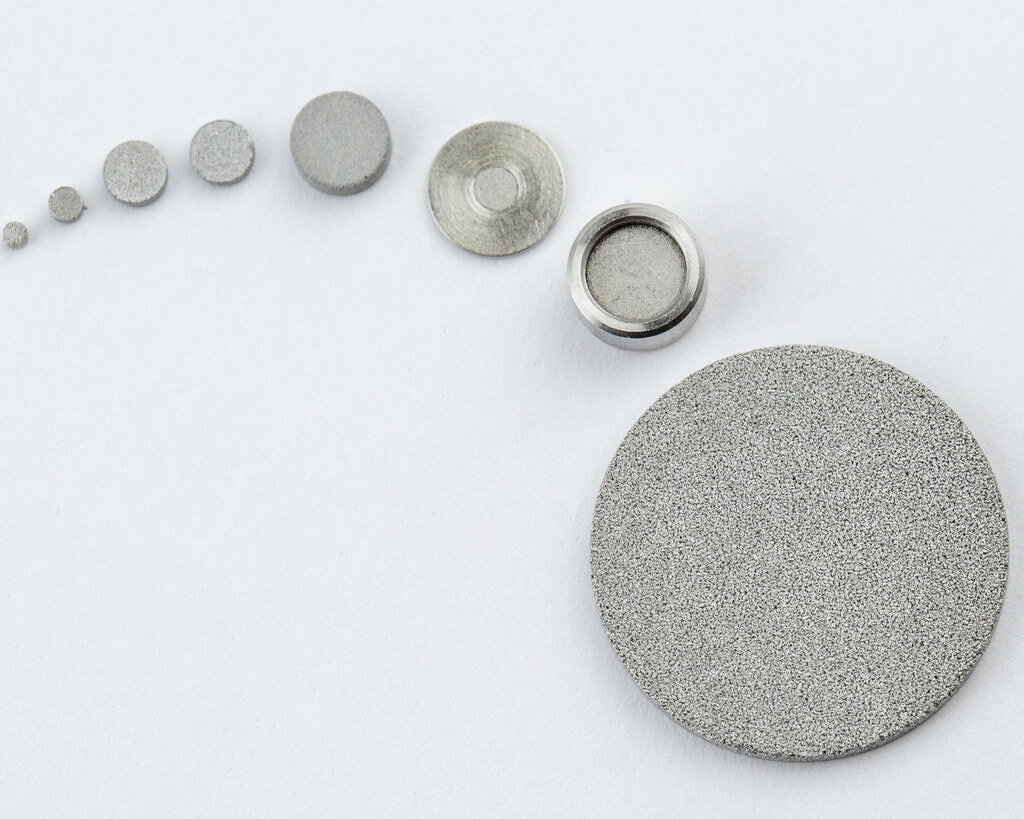
OPTI-FRIT sintered frits are precision-engineered porous metal filtration components for liquid chromatography, mass spectrometry, flow control, and OEM fluidic applications. Manufactured by Optimize Technologies in Oregon City, Oregon, OPTI-FRIT frits are available in stainless steel and titanium configurations with controlled porosity, custom dimensions, and documented testing options.
Best Suited For
OPTI-FRIT sintered frits are best suited for OEM chromatography assemblies, HPLC and UHPLC column frits, LC/MS-compatible filtration components, custom porous metal frits, flow restrictors, and precision fluid-control applications.
- OEM chromatography and analytical instrument assemblies
- HPLC and UHPLC column frit applications
- LC/MS-compatible filtration and fluidic components
- Custom stainless steel or titanium porous metal frits
- Flow restrictors and precision fluid-control components
- Replacement frits for specialized chromatography workflows
Need a replacement element for an existing Optimize filter? OPTI-FRIT is intended for custom, OEM, column, and specialized frit requirements. For replacement elements used with existing Optimize filtration products, browse Universal LC Filtration and select the replacement specified for your filter system. These replacement elements should not be treated as universal substitutes for unrelated column or OEM frits.
Precision Sintered Frits for Chromatography
Frits play a critical role in HPLC, UHPLC, LC/MS, and analytical fluidic systems. They help retain particles, support filtration, manage flow, protect sensitive components, and contribute to consistent system performance. For OEMs, column manufacturers, instrument builders, and laboratories with specialized requirements, the right frit material, porosity, diameter, and thickness can make a measurable difference.
Whether you need stainless steel frits, bioinert titanium frits, custom pore sizes, unusual diameters, controlled thickness, or application-specific testing, Optimize Technologies can help develop a frit solution around your requirements.
Why Choose OPTI-FRIT?
Material Options
Available in 316L stainless steel or bioinert titanium for demanding chromatography, LC/MS, and high-pressure fluidic applications.
Controlled Porosity
For 316L stainless steel, current manufacturing capability ranges from 0.1 micron to 20 micron. Titanium porosity capabilities should be confirmed for the specific application.
Custom Dimensions
Frit diameter, thickness, and geometry can be tailored to match OEM assemblies, replacement needs, or specialized flow paths.
Tested Performance
Available testing includes flow, backpressure, bubble point, particle retention, and mass spectrometry validation.
Documentation Available
Testing certificates are available for traceability, compliance support, and internal quality documentation.
Chromatography-Focused
Designed for LC, LC/MS, OEM chromatography, system testing, flow restrictors, and critical filtration applications.
Built for OEMs, Column Manufacturers, and Specialized LC Applications
OPTI-FRIT is currently offered as a custom quote product line. If you are developing an OEM assembly, sourcing frits for column manufacturing, replacing an existing frit, or trying to solve a filtration, flow, or backpressure issue, send us your specifications and application details. Our team can help evaluate material, porosity, size, thickness, testing needs, and production volume.
Common OPTI-FRIT Applications
- HPLC and UHPLC column frits
- LC/MS filtration and fluidic components
- OEM chromatography assemblies
- Inline filtration and sample path protection
- Flow restrictors and precision fluid-control components
- Analytical instrument testing and validation
- Custom porous metal filtration components
- Replacement frits for specialized chromatography workflows
How to Choose the Right Frit
Choosing the right frit depends on the application, particle size, solvent environment, pressure requirements, flow rate, compatibility needs, and whether the frit will be used in a standard laboratory workflow or an OEM assembly.
Material
Material selection should be based on the application, solvent conditions, compatibility requirements, and whether the frit will be used in a standard chromatography workflow, a bioinert application, or a custom OEM assembly. OPTI-FRIT sintered frits are available in 316L stainless steel and titanium. For a deeper comparison, read our guide to stainless steel vs titanium frits for HPLC, UHPLC, and LC/MS.
When corrosion resistance is a concern, titanium may be a better starting point depending on the solvent environment and application requirements. If you are unsure which material is appropriate, send us your application details, drawing, sample, or existing part number for review.
Porosity
Porosity should be selected based on the particles being retained, system pressure, flow rate, solvent environment, assembly geometry, and application requirements. Smaller pore sizes can provide finer particle retention, but may also increase flow restriction or backpressure. Larger pore sizes may reduce restriction, but may not provide the same level of fine-particle retention. For more detail, see our guide on how to choose the right HPLC frit porosity.
Diameter and Thickness
Frit diameter and thickness affect fit, mechanical support, pressure behavior, flow characteristics, and assembly compatibility. OPTI-FRITs can be customized to match application-specific requirements.
Testing Requirements
Depending on your application, testing may include flow, backpressure, bubble point, particle retention, mass spectrometry validation, and documentation certificates. If your system is experiencing pressure problems, read our troubleshooting guide on what causes HPLC frit clogging and high backpressure.
Helpful OPTI-FRIT Selection Guides
Use these guides to compare frit materials, choose porosity, and troubleshoot frit-related pressure problems before requesting a custom quote.
Stainless Steel vs Titanium Frits
Compare stainless steel and titanium frits for HPLC, UHPLC, LC/MS, bioinert workflows, and OEM chromatography applications.
How to Choose HPLC Frit Porosity
Learn how pore size affects particle retention, backpressure, flow rate, and frit performance in chromatography systems.
Frit Clogging and High Backpressure
Understand common causes of frit clogging, rising system pressure, restricted flow, and filtration-related troubleshooting issues.
OPTI-FRIT Manufacturing Capabilities in 316L Material
The table below shows available nominal frit diameters and current dimensional requirements for OPTI-FRIT manufacturing capabilities in 316L stainless steel. Inch dimensions are primary; metric diameters are reference conversions.
| Nominal Frit Diameter (in.) | Nominal Frit Diameter (mm) | Diameter Tolerance | Frit Thickness Tolerance |
|---|---|---|---|
| 0.039 | 0.99 | +/- 0.002 in. | +/- 0.004 in. |
| 0.044 | 1.12 | +/- 0.002 in. | +/- 0.004 in. |
| 0.062 | 1.57 | +/- 0.002 in. | +/- 0.004 in. |
| 0.083 | 2.11 | +/- 0.002 in. | +/- 0.004 in. |
| 0.093 | 2.36 | +/- 0.002 in. | +/- 0.004 in. |
| 0.118 | 3.00 | +/- 0.002 in. | +/- 0.004 in. |
| 0.120 | 3.05 | +/- 0.002 in. | +/- 0.004 in. |
| 0.125 | 3.18 | +/- 0.002 in. | +/- 0.004 in. |
| 0.157 | 3.99 | +/- 0.002 in. | +/- 0.004 in. |
| 0.181 | 4.60 | +/- 0.002 in. | +/- 0.004 in. |
| 0.187 | 4.75 | +/- 0.002 in. | +/- 0.004 in. |
| 0.250 | 6.35 | +/- 0.003 in. | +/- 0.004 in. |
| 0.375 | 9.53 | +/- 0.003 in. | +/- 0.004 in. |
| 0.500 | 12.70 | +/- 0.005 in. | +/- 0.007 in. |
| 1.000 | 25.40 | +/- 0.008 in. | +/- 0.009 in. |
Tolerance values shown are the current dimensional requirements for OPTI-FRIT manufacturing capabilities in 316L material. Metric diameters are reference conversions based on 1 in. = 25.4 mm.
Current 316L Manufacturing Capability Ranges
| Capability | Minimum | Maximum | Unit |
|---|---|---|---|
| Frit Thickness | 0.010 | 0.125 | in. |
| Pore Size | 0.1 | 20.0 | micron |
Minimum and maximum values define Optimize Technologies' current manufacturing capability limits for 316L material.
Need a frit outside these listed dimensions?
Send us your application requirements, drawing, sample, or existing part number. Optimize Technologies can review custom tooling, dimensions, porosity, testing requirements, and production volume for your application.
Custom Frit Capabilities
Optimize Technologies can work with customers to tailor sintered frits to specific performance and assembly requirements. Custom options may include material, outside diameter, thickness, porosity, testing requirements, and lot size.
Custom tooling options are available when an application requires a frit that does not match a standard configuration. Typical custom lead times may vary depending on material, geometry, testing, and production requirements.
Helpful Information for a Quote
- Material preference: 316L stainless steel, titanium, or application-specific recommendation
- Outside diameter and thickness
- Target porosity
- Quantity or estimated annual usage
- Application: HPLC, UHPLC, LC/MS, OEM assembly, flow restrictor, filtration, or other use
- Pressure, flow, and solvent conditions
- Testing or certificate requirements
- Drawing, sample, or existing part number if available
Have some of these details ready?
Send us what you know. If you are not sure about a specification, describe the application or the problem you are trying to solve, and our team can help review the request.
Related Optimize Technologies Resources
These related pages may also be helpful if you are evaluating frits as part of a larger chromatography, filtration, or OEM fluidic assembly.
Frequently Asked Questions
What is a frit in HPLC?
In HPLC and UHPLC systems, a frit is a porous component used to retain particles, support filtration, distribute flow, or protect sensitive fluidic components. Frits are commonly used in columns, filters, fittings, and OEM assemblies.
Can OPTI-FRIT frits be customized?
Yes. OPTI-FRIT frits can be quoted around custom requirements such as material, diameter, thickness, porosity, testing, and lot size.
Can I order small quantities of custom frits?
Optimize Technologies can review requests for prototype, small-lot, and production quantities. Availability, pricing, and lead time depend on material, geometry, porosity, testing requirements, and current production needs.
Can Optimize Technologies make frits from a drawing or sample?
Yes. A drawing, sample, or existing part number can help the team evaluate the required outside diameter, thickness, porosity, material, and performance requirements.
What information is needed to quote a custom HPLC frit?
Helpful quote details include material preference, outside diameter, thickness, target porosity, quantity, application, pressure and flow conditions, solvent compatibility, testing requirements, and any available drawing, sample, or existing part number.
When should I choose titanium instead of stainless steel?
Titanium may be preferred when bioinert performance, corrosion resistance, or application-specific compatibility is important. Stainless steel is commonly used for robust chromatography and general high-pressure filtration applications. For more detail, read our guide to stainless steel vs titanium frits.
How do I choose the right frit porosity?
Frit porosity should be selected based on the particles being retained, flow requirements, system pressure, and application goals. For additional guidance, read how to choose the right HPLC frit porosity.
What causes frit clogging and high backpressure?
Common causes include particulates, sample debris, precipitated buffers, incompatible solvents, column packing material, biological residue, or using a frit porosity that is too restrictive for the application. Read more about HPLC frit clogging and high backpressure.
Can OPTI-FRIT frits be used by HPLC column manufacturers?
Yes. OPTI-FRIT sintered frits can be evaluated for column manufacturing, OEM chromatography assemblies, and specialized LC applications where material, dimensions, porosity, and testing requirements need to be controlled.
Are OPTI-FRIT frits made in the USA?
Yes. OPTI-FRIT sintered frits are manufactured by Optimize Technologies in Oregon City, Oregon.
Are OPTI-FRIT frits available for online purchase?
OPTI-FRIT is currently offered as a custom quote product line. Contact Optimize Technologies with your requirements, and our team will help determine the best configuration.
Are testing certificates available?
Yes. Testing certificates are available to support traceability, quality documentation, and application requirements.
Can OPTI-FRIT frits be used in flow restrictors?
Yes. OPTI-FRIT frits can be tailored for flow restrictors and other precision fluid-control applications.
Request a Quote for OPTI-FRIT Sintered Frits
Send us your frit requirements, drawing, sample, or application details. Optimize Technologies can help you evaluate material, porosity, size, thickness, testing, and production options for HPLC, UHPLC, LC/MS, OEM, and custom filtration applications.